Those who read this site know that I hold the Ferronato wine bar in Pordenone in high regard. However, due to life circumstances, I won’t be returning to the area for a few months. So, I bid farewell to this lovely establishment with some thoughts on the wines I tasted in July and a broader reflection on how to recognize a good wine bar (defined as a place where you can also enjoy wine by the glass). In my opinion, good wine bars have five characteristics that can be arranged in a pyramid: the first two are essential—without them, we wouldn’t be talking about wine bars but just regular bars. That’s fine, but it’s something else entirely. Then, there are three additional steps of decreasing importance that can make a place our favorite spot.
The Fundamental Characteristics of Good Wine Bars
Good wine bars have two fundamental characteristics:
Newsletter
The best wines, no boring scores
1. Quality of the Wines
This may seem obvious, but take a look at the reviews of wine bars in your area: rarely is the wine itself discussed. Service, location, prices—these are mentioned, but little is said about the wines. This is akin to reviewing a restaurant without mentioning what was eaten. Perhaps it’s due to a lack of wine education, but wine bars are establishments that literally wouldn’t exist without wine. The quality of the wines offered can be broken down into three parameters:
- Bottle Selection: Are there only cheap wines, or are there also medium-to-high level bottles? And, most importantly, did we drink well?
- Range of Offerings: Just one sparkling wine, one white, and one red? Or twenty potential choices?
- Frequency of Change in Offerings: Always be wary of glossy menus—it means the offerings never change. We want a wine bar that explores, and exploration inevitably leads to change. I trust chalkboards and hastily printed menus far more than stylish restaurant booklets.
2. Service Quality
This is a quality that is too often underestimated. Wine needs to be properly served, especially when we’re talking about glasses costing €5 or more. Generally, a large influx of customers suggests that bottles don’t remain open for too long, which, even if we don’t like crowds, reduces the risk of being served stale wine. Here again, the parameters to evaluate are three:
- Temperature: As mentioned in my review of the wine bars in Massa Marittima, Suvereto, and Bolgheri, it drives me crazy when red wine is served at the temperature of potato soup or, more rarely, when white wine is served too cold. A wine bar should invest in temperature control systems that highlight its products.
- Glassware: Riedel glasses are beautiful—they can even make mediocre wine taste good. And how sad it is to see great wines served in thick, clunky glasses.
- Water and Bread: There are casual drinkers, and then there are us, the enthusiasts. We know well that certain wines, especially the great ones, leave a significant imprint on the palate: something is needed to reset it, or else we end up mixing grand crus together.
The Extras That Make a Good Wine Bar Great
There are three extra elements that can elevate a good wine bar to a great one:
- Half Glass: For those like me (and you, who are reading) who visit wine bars more to discover wines than to have something to sip with company, the option to buy 1/16 of a bottle instead of 1/8 is invaluable. It allows for more tasting, and, more importantly, this format is often offered for wines that, when ordered by the full glass, would have significant prices. Long live the 1/16.
- Staff: Of course, it’s nice to be treated kindly. But I’ve also noticed that wine bar staff tend to be slow. Perhaps the underlying logic is that wine enthusiasts like to take their time, or maybe I’m just impatient. Either way, I prefer swift service.
- Furnishings: This is a matter of personal taste. I like wine bars with traditional furnishings. Ferronato is an excellent example: lots of wood, bottles displayed with no artistic pretense, old-fashioned floors. However, there are exceptions—Wein&Co’s flagship at Stephensplatz in Vienna is splendidly modern, with contemporary yet comfortable furnishings that match the great wines on offer. It’s a matter of taste.
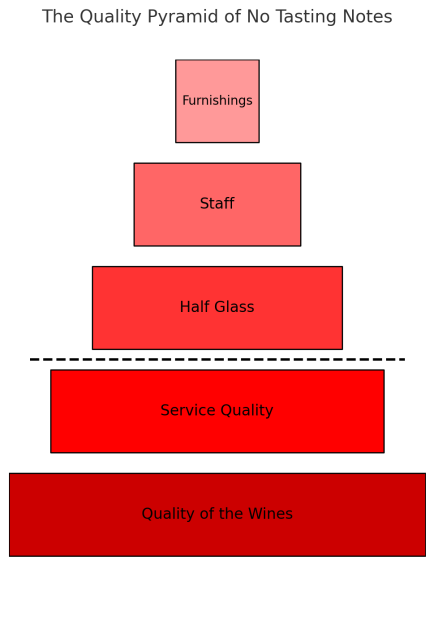
And now, let’s get practical.
The first wine bar reviewed based on this quality pyramid is Wein & CO in Hietzing, but I have also examined Severino in Padua.
Ferronato July 2024 – The Tastings
The Bubbles
Crémant de Bourgogne Blanc de Blancs Brut N.V. – André Delorme
A fresh Crémant with notes of apple and pear and a dry palate. Splendid, fine, and diffuse perlage. Lively acidity and good sapidity complete the sip.
Alta Langa Contessa Rosa Rosé – Fontanafredda
A yellow-pink color and an intriguing nose with hints of gunpowder and red fruits. Fine, persistent, and rich perlage. On the palate, the flavors blend with an intriguing sapidity that dries the mouth. The finish is direct and powerful, like a firework explosion.
Brut Origine Champagne – Etienne Oudart
Notes of yeast, sourdough, and custard characterize this Champagne, with a fine perlage as it should be. On the palate, there’s perhaps too marked an evolution, with a finish of toasted hazelnuts.
Grande Réserve Brut Champagne Premier Cru – Crucifix
A high-quality perlage: fine, dense, and widespread, with vigorous foam. The nose offers notes of yeast and cream, while the palate is complex and evolved, with delicate and precise elegance. Joyful finish.
The Whites
Passobianco – Passopisciaro
The wood is well integrated, with hints of sweet orange, marzipan, and a touch of lemon. Vibrant acidity accompanies a sip rich in pastry and caramel notes, with a tangy and dynamic finish reminiscent of orange juice.
Etna Bianco – Tenuta delle Terre Nere
Initial attraction with notes of cocoa butter, cheese rind, and jasmine. Soft on the palate, with a sharp, citrusy finish, well balanced by a pleasant sapidity. The acidity is moderate, but the sip tends to tire quickly. In general, while recognizing the medium-high quality of the Etna whites I’ve tasted so far, I find it hard to understand the hype. More investigation is needed.
Tralivio – Sartarelli
A straightforward and elementary Verdicchio, but with surprising power. Nose of white flowers, peach, and a hint of petrol. Dense and fresh on the palate, with well-defined acidity and a nice sapidity that envelops the sip.
Derthona Piccolo – Vigneti Repetto
Delicate nose with notes of cocoa butter, apple, citrus, and apricot. However, on the palate, it feels a bit tired and lacks fruit density, seeming somewhat muted. The finish is simple. Overall, disappointing.
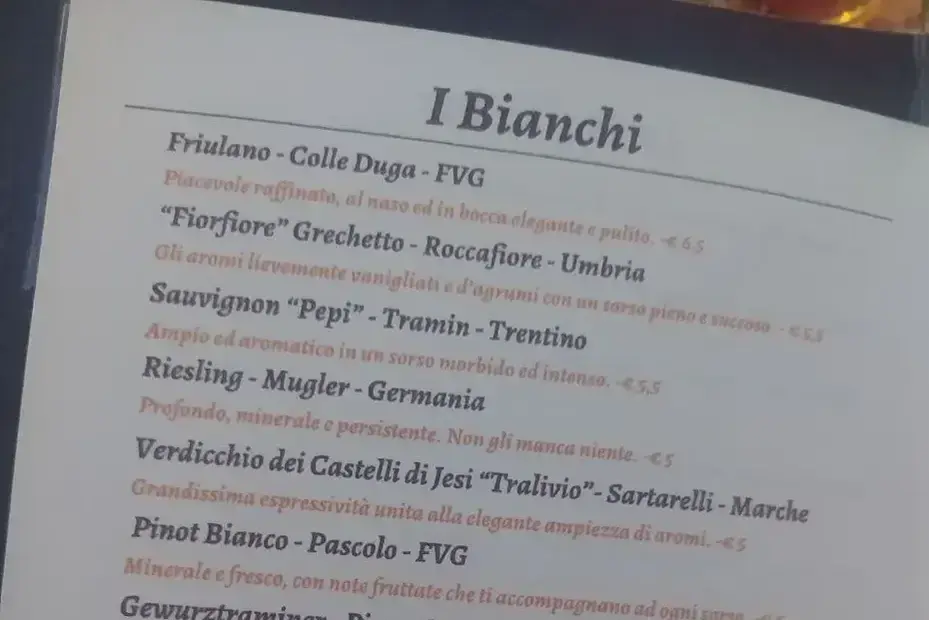
Friulano Collio – Colle Duga
A pleasant surprise. Rich and abundant aromas: freshly cut grass, pear, crushed rock with the verticality of Collio and Gorizia. An enveloping and multifaceted sip in all its phases, with profiles of apple, aromatic herbs, and floral notes. Good acidity hidden in the fruit that then returns in a slight murmur on the lips and a splendid concentration that evolves the sip with fruity notes. Long and satisfying finish, powerfully saline, fresh, and silky like the body, only slightly almondy. The best wine of this tasting round. I had a low opinion of Colle Duga, but this experience invites further exploration.
The Reds
Rosso di Valtellina – ARPEPE
The nose reveals small red fruits, meat, and warm spices, creating an inviting and engaging bouquet. On the palate, the acidity is perfectly balanced with a soft and velvety tannin. The palate reveals further notes of cinnamon and raspberries, with a long, slightly savory, and discreet finish that gives elegance to this simple but refined wine.
Franconia – Gradis’Ciutta
A somewhat rough wine, but charmingly so. Scents of blueberries, berries, with a pronounced Maillard reaction and spices. The acidity is on the verge of being sour, accompanied by a grainy tannin that envelops the mouth. It leans towards the rusticity of Refosco with a spicy finish. Perfect for a barbecue.
Newsletter
The best wines, no boring scores