Riesling can be either dry or sweet: the same grape yields completely dry wines – such as most Austrian Rieslings and German Grosses Gewächs – and sweet wines, ranging from off-dry versions to noble rot Trockenbeerenauslese. Three clues are enough to tell which one is in your glass: the words on the label, the alcohol level, and the region of origin. Those already familiar with the comparison between Grüner Veltliner and Riesling know that, dry or sweet, the common thread remains acidity.
Riesling is perhaps the most indecisive grape in the world, or the most versatile: the same grape that pairs with a spicy Thai dish at lunch is poured over an apricot tart at the end of dinner, and in between lies a spectrum of nuances that Germany saw fit to codify with words as long as freight trains. No need to panic: behind a name like Trockenbeerenauslese lies a precise logic, and once you understand it, choosing the right bottle becomes much simpler.
Newsletter
The best wines, no boring scores
- Dry or sweet: it depends on how much sugar remains in the wine after fermentation, the residual sugar;
- Label: trocken means dry, feinherb slightly off-dry; Kabinett, Spätlese and Auslese indicate grape ripeness, not necessarily sweetness;
- Alcohol: below 10 degrees Riesling is almost always sweet, above 12 almost always dry;
- Regions: Austria and Australia make it almost always dry, the Mosel often sweet;
- Acidity: high in every version, and it is acidity that balances the sugar.
What Is Riesling: Characteristics
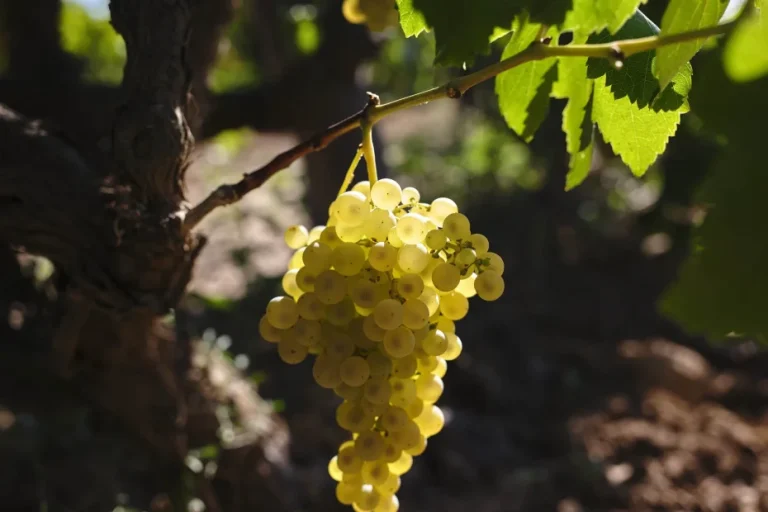
Riesling is a white grape variety originating from the Rhine Valley in Germany, where it appears in a document as early as 1435. It has small, compact clusters, thin skin and late ripening, which is why it thrives in cool climates, where it ripens slowly while retaining very high acidity. It is aromatic but not overpowering, and precisely reflects the soil on which it grows, from the slate of the Mosel to the gneiss of the Wachau. Unlike Chardonnay, it spans the entire sweetness scale: Chardonnay is almost always made dry, while Riesling ranges from bone dry to very sweet.
- Acidity high and sharp – the grape’s true signature;
- Aromas of citrus, green apple, peach, apricot and white flowers in young wines;
- Petrol notes, the celebrated petroleum character, which appear with age or in warm, sunny vintages;
- Body from light to medium in dry versions, fuller in sweet wines and in old-vine wines;
- Alcohol moderate, from 7-8 degrees in sweet Kabinetts to 13-14 in great dry wines;
- Longevity extraordinary, spanning decades.
Riesling is a light wine in most of its versions: a slender body, restrained alcohol and an acidity that makes it lively; it becomes fuller only in Austrian Smaragd, German Grosses Gewächs and sweet botrytised wines. For those approaching wine for the first time, Riesling is not the easiest starting point: a young dry version can come across as acidic and sharp, while a slightly sweet Kabinett is a far more welcoming entry point.
Where and How Riesling Is Made
Germany is the world’s leading producer of Riesling, with around a quarter of its vineyards dedicated to this grape, but the variety has also found a home in Austria – above all in the Wachau, Kamptal and Kremstal – in Alsace, in Australia in the Clare and Eden Valleys, and then in New Zealand, New York State and Canada. Everywhere it seeks the same conditions: a cool climate, a long ripening season and poor soils, often on steep slopes. The result, however, varies greatly from one region to another, because few grapes convey terroir with such transparency.
- Climate: the cooler it is, the more tense and citrus-driven the wine; in warmer regions tropical fruit and petrol notes come to the fore;
- Soil: the Mosel’s slate yields light, smoky wines; the Wachau’s gneiss and granite gives more structured wines; Alsace’s limestone and marl soils produce broader wines;
- Harvest timing: a late harvest concentrates sugars and allows for sweet wines;
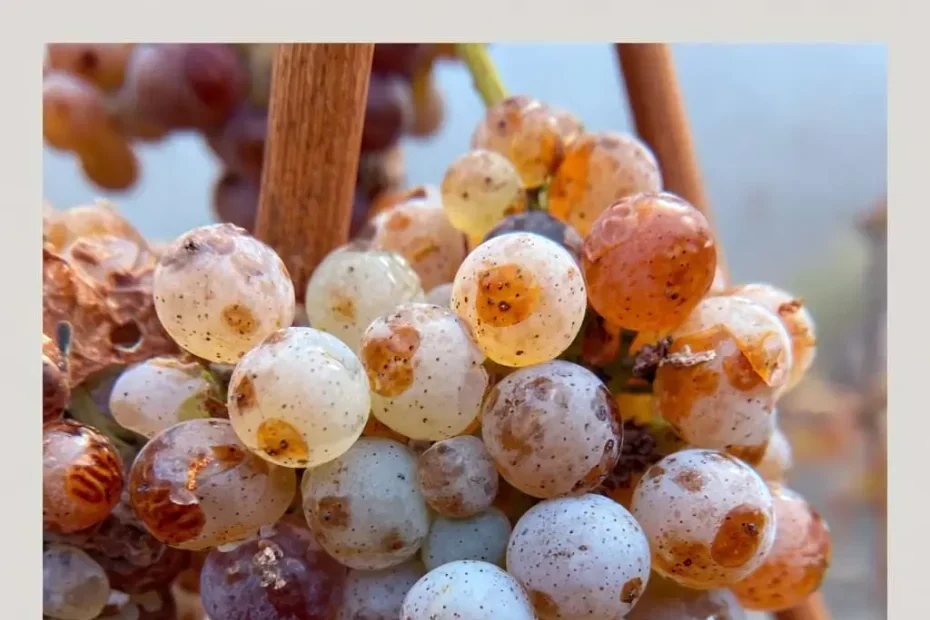
- Noble rot (Botrytis cinerea): dehydrates the berries and yields the great sweet wines such as Beerenauslese and Trockenbeerenauslese;
- Fermentation: stopping it before all the sugar converts to alcohol leaves residual sugar;
- Ageing: almost always in steel or large, used wooden casks, so as not to mask the fruit.
In the cellar, Riesling asks for little and gives back a lot: most producers work at low temperatures, protect the must from oxygen and avoid new wood, in order to preserve the acidity and fruit aromas. The decisive choice concerns sugar. For a dry Riesling, the must is allowed to ferment completely; for an off-dry or sweet wine, fermentation is halted with cold and filtration, or the starting point is grapes so ripe or botrytised that the yeasts cannot consume all the sugar. Malolactic fermentation is generally avoided as well, since it would soften the acidity.
How to Drink Riesling: Food Pairings
Riesling is one of the most versatile food wines and works at every stage of a meal. As an aperitif, light and fresh Rieslings work perfectly – a Wachau Federspiel or a Mosel Kabinett, perhaps alongside fresh cheeses or smoked salmon. During the meal, dry versions pair with fish, shellfish, white meats and pork, while those with a hint of sweetness are among the few wines capable of standing up to spicy Asian cuisine: the sweetness tames the heat and the acidity cleanses the palate. At the end of the meal, Auslese and noble rot wines pair with fruit tarts, apricot desserts and blue cheeses.
It is also worth thinking by region. Mosel Rieslings, light, low in alcohol and often off-dry, are ideal with Thai and Vietnamese cuisine, curry and sushi. Wachau Smaragd and German Grosses Gewächs, more structured, stand up to richer dishes such as roast chicken, pork loin or a Wiener Schnitzel. Alsace, with its broad and spicy Rieslings, finds its natural partner in choucroute and fish in sauce. Australian Rieslings from Clare and Eden Valley, bone dry and citrus-driven, are perfect with oysters and raw seafood. In my notes, some of the best pairings have been precisely with spicy Asian dishes.
What Is Sweet Riesling: the History
For much of its history, Riesling was a sweet wine. In the cold of Germany the grape struggled to ripen, and high sugar was the mark of an exceptional vintage: legend has it that in 1775, at Schloss Johannisberg, the delay of the messenger who was supposed to authorise the harvest gave rise to the first Spätlese. In the nineteenth century, sweet Rhine Rieslings fetched prices on a par with the great Bordeaux. Then, in the post-war years, the industry flooded the market with cheap, sweetish wines like Liebfraumilch, and Riesling suffered a reputation damage it has not entirely shaken off to this day.
- Mosel, Rheingau and Nahe, where Kabinett, Spätlese and Auslese remain the tradition and very high acidity balances the sugar;
- Germany and Austria, for noble rot wines, Beerenauslese and Trockenbeerenauslese, produced only in favourable vintages;
- Eiswein, from grapes frozen on the vine, increasingly rare with climate warming;
- Alsace, with Vendanges Tardives and Sélection de Grains Nobles;
- Canada and New York State, for Icewine.
- Trocken
- Dry, with minimal residual sugar.
- Feinherb / Halbtrocken
- Slightly off-dry.
- Kabinett
- The lightest of the Prädikat wines, often with a hint of sweetness.
- Spätlese
- Late harvest, from riper grapes.
- Auslese
- Selected, very ripe clusters: usually sweet, dry if trocken also appears on the label.
- Beerenauslese / Trockenbeerenauslese
- Overripe or noble rot-shrivelled berries, selected one by one: very sweet and rare wines.
A good sweet Riesling is never cloying: high acidity balances the sugar, alcohol stays low – often between 7 and 9 degrees – and the wine can age for decades, developing notes of honey, dried apricot, tropical fruit and petrol. This is why the tradition endures, even as today’s tastes move elsewhere: the most successful sweet Rieslings come above all from the Mosel, Rheingau and Nahe, where steep slopes and slate soils yield ripe yet still intensely acidic grapes. In a No Sediment video, Ernst Loosen once said that his grandfather never tasted a dry Riesling. Times change, and perhaps it was once easier to fall in love with this variety. And yet – if we buy a few already mature bottles, or simply forget some in the cellar – wines born in cold climates will take us to a tropical paradise, which is, in my entirely personal theory, precisely the reason Riesling found such success in countries that have very little that is tropical about them.
My Impressions: Riesling in the Glass
Riesling is a world unto itself. The German tradition, so rich in both classifications and different styles, has given this grape a complexity of interpretation comparable only to that of Burgundy Pinot Noir. It is not, however, an experience accessible to everyone, for many reasons.
There is the factor of nomenclature and classifications – fascinating for those who approach them, yet also extremely intricate and far from straightforward for the only moderately motivated enthusiast. There is the economic factor: a good Riesling, especially an Austrian or German one, often costs. And finally there is the trend towards dry, direct wines that often, at least in youth – and unfortunately we are drinking wines that are far too young more and more frequently – makes these bottles seem acidic, sharp and not particularly seductive.
The common thread running through almost all my notes is acidity, described variously as the backbone, pivot or pillar of the wine: it is acidity that supports the fruit and gives direction to the sip, even in the richest wines. One impression of an Australian Riesling – Penfolds’ Bin 51, tasted a few months ago – summed it up well:
We talk about Riesling, but in the end we are mostly talking about acidity.
From my tasting notes
How acidity makes itself felt, however, changes. In the Wachau – from Tegernseerhof to Hirtzberger through to Knoll’s Kellerberg – it frames a rich, concentrated, often tropical fruit, sometimes hiding within it. In the Kamptal it is more exposed, steely, and in the simpler versions it leaves the wine feeling hollow. In Germany I have often found it bristly in young dry wines, while in Kabinett and Auslese it becomes the counterweight to sweetness.
Germany, the Disneyland of Riesling
Germany is the home of Riesling. The first written mention of the variety dates back to 1435, in a cellar inventory from Rüsselsheim on the Main, and in the centuries that followed monasteries and noble families made it the emblematic grape of their estates along the Rhine and the Mosel. In 1971 the wine law codified the Prädikat system, which classifies wines according to the ripeness of the grapes at harvest, and from the 1980s the dry wine movement reshuffled the deck once more, culminating in the Grosses Gewächs of the VDP association – the great dry crus.
Riesling is Germany’s principal grape because it is made for its climates: it ripens late but withstands winter cold well, takes full advantage of the steep, sun-facing slopes along the rivers and retains an acidity that would be lost elsewhere. Today it covers around a quarter of German vineyards – the largest surface area in the world for this variety – and yields very different wines: light and smoky in the Mosel, elegant in the Rheingau, powerful in the Palatinate, taut and deep in the Nahe.
I only recently began to explore German Riesling in depth, and my first experiences illustrate the country’s variety well. At a dedicated tasting I came across the Auslese Felsterrasse Trocken 2020 by Clemens Busch – exceptional and dry despite the word Auslese – alongside the Grosses Gewächs of Schäfer-Fröhlich and the Schlehdorn of Peter Jakob Kühn, rich but still with a bristly acidity. At VieVinum, Dönnhoff’s Kabinett won me over with its barely-there sweetness, while a 1981 Spätlese from Bürklin-Wolf had by then lost its way.
Dry Riesling vs Sweet Riesling: the Differences
Dry and sweet are two different ways of vinifying the same grape. Here are the main differences:
| Characteristic | Dry Riesling | Sweet Riesling |
|---|---|---|
| Residual sugar | Minimal (trocken) | From around 20 g/l to over 150 g/l |
| Alcohol | 11.5-14% | 7-10% |
| Body | Light to medium, full in Smaragd and GG | Light (Kabinett) to dense and unctuous (TBA) |
| Aromas | Citrus, green apple, peach, wet stone | Apricot, honey, tropical fruit, candied citrus |
| Acidity | High, in the foreground | High, balanced by sugar |
| Typical regions | Austria, Alsace, Australia, German GG | Mosel, Rheingau, Nahe, Alsace (VT and SGN) |
| On the label | Trocken, Smaragd, Federspiel, GG | Kabinett, Spätlese, Auslese, BA, TBA, Eiswein |
| Pairings | Fish, shellfish, white meats | Spicy Asian cuisine, fruit desserts, blue cheeses |
| Ageing | From 5 to over 20 years | Over 30 years and beyond |
In short, the difference between a dry and a sweet Riesling depends on how much sugar the producer leaves in the wine – a choice tied to grape ripeness, climate and regional tradition. The dry style aims for tension, savouriness and the ability to accompany food; the sweet style for richness, low alcohol and longevity, because sugar and acidity together protect the wine over time. In both cases it is acidity that holds the wine together: without it, the dry would be flat and the sweet cloying. To tell them apart before pulling the cork, the label and the alcohol level are enough: a Riesling below 10 degrees is almost always sweet, one above 12 almost always dry, while the word trocken removes any doubt.
Which Is the Driest Riesling
In general, the driest Rieslings are Austrian and Australian. In Austria, almost all quality Rieslings – from the Wachau to the Kamptal – are made dry, and in the Wachau the Steinfeder, Federspiel and Smaragd categories are reserved for dry wines; in the Clare and Eden Valleys, Riesling is traditionally bone dry, sharp and citrus-driven. German Grosses Gewächs follow, which by regulation must be dry, along with Germany’s trocken wines. Alsace is the least predictable region, as many of its Rieslings retain a slight residual sugar even when the label does not declare it. Here is an approximate scale, from driest to sweetest:
- Australian Rieslings from Clare and Eden Valley and Austrian Rieslings (Smaragd, Federspiel, Kamptal and Kremstal DAC);
- Grosses Gewächs and German trocken Rieslings;
- Dry Alsace Rieslings;
- German Feinherb and Kabinett;
- Spätlese and Auslese;
- Beerenauslese, Trockenbeerenauslese and Eiswein.
A good example of a dry Austrian Riesling is the Ried Heiligenstein 2018 by Hirsch, from the Kamptal, which I drank in July with a fried fish in tamarind sauce. The warm vintage gave it an unusual richness for the producer’s style: tropical fruit, pear, butter and a slightly reductive note of flint. Yet the wine remains dry, with an acidity perfectly folded into the fruit that drives the sip like a precise bowling throw that slowly knocks down the last pin, through to a saline finish of around 35 seconds. The fruit, however, seemed already a little faded: a very good wine that would have been more complete a couple of years ago.
For a truly dry Riesling, Austria remains the safest choice; for exploring sweetness, Germany has no rivals.
Newsletter
The best wines, no boring scores